
See six common rooftop unit problems, their early warning signs, and how sensor data helps prevent expensive HVAC failures.
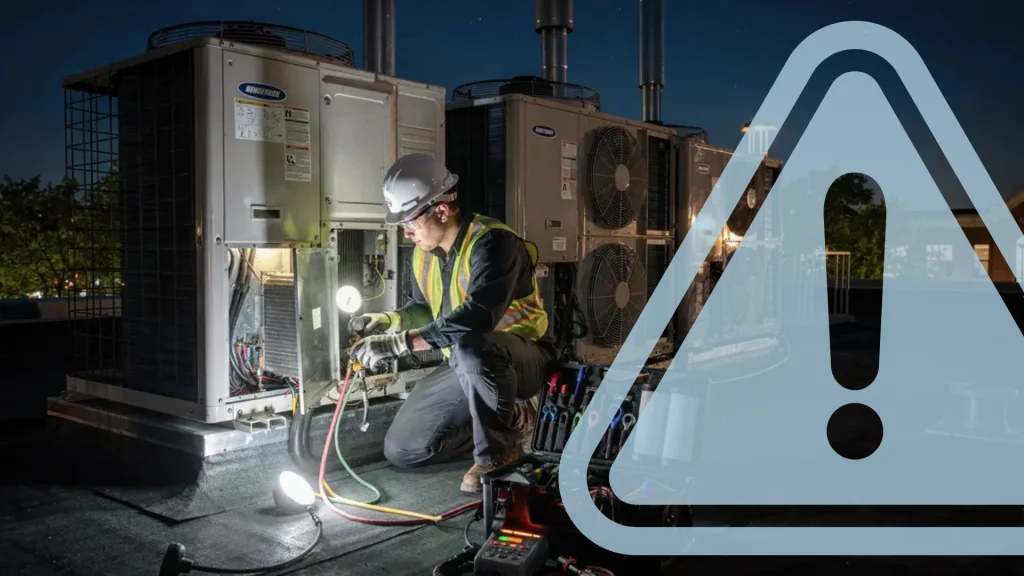
Fan belts wear out, motors fail, control boards stop communicating, and airflow restrictions gradually reduce performance long before a rooftop unit completely shuts down. These issues often begin with subtle warning signs that are easy to miss during routine operations but can eventually lead to higher energy costs, uncomfortable spaces, and unexpected repair bills.
This article explores six common rooftop unit problems, the early indicators facility teams should watch for, and how Cirkuit’s wireless sensors help identify changes in performance before they become major disruptions. From airflow issues and short cycling to water leaks and ventilation concerns, better visibility helps teams respond faster and keep HVAC systems operating reliably.
Why Rooftop Unit Problems Are So Easy to Miss
By design, a rooftop unit stays out of view. Inspections tend to be scheduled at intervals, and early trouble often only appears as a subtle comfort shift, a slight increase in energy usage, or the occasional tenant complaint that may be overlooked. When a problem is finally obvious, the costs are already adding up.
Our article on RTU visibility for smarter retail HVAC operations discusses how a rooftop unit often runs in isolation with minimal supervision. This can lead to uneven temperatures, increasing energy costs, and more frequent equipment operation than needed. Sensor-based monitoring fills the information gap between routine maintenance, letting teams respond to data before small issues cause significant repair needs.
1. Dirty Filters
Clogged filters make it harder for air to move, pushing equipment to work overtime and lowering indoor air quality. The U.S. Department of Energy notes that dirty filters can drive HVAC energy use up by about 15%. Over time, blocked airflow risks evaporator coil freezing, can shorten the lifespan of a rooftop unit, and creates uneven temperatures in different areas.
How to Catch Dirty Filters Early
Dirty filters aren’t visible from ground level, but their effects are. Cirkuit’s indoor air quality sensors monitor airborne conditions in real time. Temperature sensors highlight areas that aren’t reaching set comfort levels. Along with power meter sensors tracking prolonged run times or abnormal energy draws, teams can spot patterns. When several readings trend together for a specific rooftop unit, it is worth investigating before tenants start raising issues.
2. Fan Belt and Fan Motor Failures
Supply fans are critical to rooftop unit performance, and problems with belts or motors can quickly affect airflow, comfort, and energy use. Worn or broken belts may slip before failing completely, while failing motors can overheat, draw excess power, or stop unexpectedly. Common causes include age, poor maintenance, bearing wear, misalignment, and excessive strain from dirty filters or blocked airflow.
Using Sensor Data to Identify Fan Problems Early
Changes in airflow rarely happen all at once. Temperature sensors can reveal zones that are no longer reaching their target conditions, even though the rooftop unit is still running. Power meter sensors help identify unusual energy patterns, such as increased electrical draw from a struggling motor or reduced consumption after a fan failure. When these readings are combined with occupant comfort data, facility teams gain earlier visibility into developing mechanical issues and can schedule maintenance before a complete breakdown occurs.
3. Control Board Faults and Failures
Control boards are the brains of a rooftop unit, managing everything from fan operation and temperature control to heating and cooling sequences. When a board begins to fail, the symptoms can vary widely. Units may short cycle, stop responding to thermostat calls, run at the wrong times, or fail to bring certain components online altogether. Electrical surges, moisture, age, and extreme temperature swings are all common contributors to control failures.
Using Sensor Data to Detect Control Issues
Control problems rarely announce themselves with a single obvious failure. Instead, they often show up as unusual operating patterns. Power meter sensors can reveal irregular run cycles, unexpected energy consumption, or equipment that repeatedly starts and stops. Temperature sensors help confirm whether indoor conditions are responding appropriately to equipment operation. When power usage, comfort levels, and occupancy patterns no longer align, facility teams have valuable information to investigate potential control board issues before they result in a complete rooftop unit shutdown.
4. Poor Ventilation
Poor ventilation often appears as stale air, odours, increased stuffiness, or higher levels of airborne contaminants. Insufficient fresh air in buildings may contribute to roughly 35% of total absenteeism. Ventilation issues aren’t always equipment failures. They may result from faulty dampers, outdated schedules, congested parts, or systems not aligned with real occupancy needs.
Monitoring Ventilation With Air Quality and Occupancy Sensors
Cirkuit’s indoor air quality sensors measure CO₂, VOCs, and other air indicators around the clock. Pairing these readings with data from occupancy sensors lets you identify where ventilation lags behind the way spaces are actually used. A rise in CO₂ in a busy area, while a nearby quiet zone stays within target, signals a distribution problem that needs attention.
5. Temperature and Humidity Anomalies
Unexpected changes in temperature or humidity are often early signs that a rooftop unit is not performing as intended. Occupants may notice rooms that feel warmer than usual, areas that remain stuffy, or spaces that seem damp even when cooling equipment is running. These conditions can point to airflow restrictions, failing components, control issues, ventilation problems, or equipment that is no longer operating efficiently.
When left unaddressed, temperature and humidity imbalances can reduce occupant comfort, increase energy consumption, and create conditions that support condensation or mould growth in certain areas of a building.
Combining Temperature and Humidity Data for Better Insights
Cirkuit’s temperature and humidity sensors continuously monitor indoor conditions and identify trends that may otherwise go unnoticed between maintenance visits. Looking at both measurements together provides a clearer picture of building performance. Rising temperatures alongside higher humidity levels can indicate cooling or ventilation problems, while isolated changes in a single zone may point to local equipment or airflow issues. By combining these insights with occupancy and air quality data, facility teams can investigate potential problems earlier and make more informed maintenance decisions.
6. Occupancy Mismatches
At times, equipment is in good condition. Yet, conditioning or ventilating incorrect spaces at off-peak times leads to both discomfort and higher costs. Some areas are over-conditioned while others are not served enough. Hybrid work patterns cause occupancy to move between floors throughout the week. With average office occupancy at 40 to 60%, roughly half of HVAC energy is spent on empty spaces.
Aligning HVAC Operation With Real Space Usage
Cirkuit’s occupancy sensors, together with motion and door or window sensors, give property teams visibility on when and how spaces are actually used. These insights can inform HVAC scheduling, ventilation approaches, or troubleshooting. They also integrate with other building management systems through Cirkuit’s open API. You can move from rigid schedules to operation based on current building use. For more details, see our occupancy sensor ROI article.
Building a Proactive Monitoring Strategy
No single sensor can address every HVAC system concern. A connected group of sensors provides a more complete view across your building. Cirkuit’s cloud dashboard brings together readings from water leak, occupancy, air quality, temperature, humidity, motion, power, and door or window sensors in one platform, with automated alerts and wireless convenience. The system is used in office towers, multi-family dwellings, hospitality, industrial, retail, and retirement settings.
When working with older properties that do not have real-time monitoring, refer to our guide on building management system upgrades for older buildings for ways to add sensor coverage without needing a full BMS upgrade.
What to Monitor Together
Some of the strongest signals arise when data points are combined. Match temperature and humidity to uncover coil or dehumidification issues. Monitor power consumption alongside comfort feedback to reveal short cycling. Line up occupancy with air quality to flag gaps in ventilation. Pair leak detection with humidity or temperature trends to catch water issues early. The objective is not to deliver a diagnosis directly from the dashboard. Rather, it is to prompt a timely investigation.
When to Escalate to Maintenance or HVAC Service
Sensors are invaluable for faster identification. However, they do not replace the expertise of an HVAC mechanic. When alerts fire, assess the trend to decide on next steps: maybe check a filter, inspect a drain, review controls, or call in an HVAC contractor. Patterns shown by sensors help prioritize work, reducing reactive maintenance which, according to industry sources, costs significantly more than planned service.
Stay Ahead of Expensive HVAC Surprises
Dirty filters, frozen coils, short cycling, poor ventilation, elevated humidity, water leaks, and occupancy mismatches often begin as subtle changes. The challenge is that without visibility, these sometimes go unnoticed until there has already been damage.
Cirkuit’s wireless smart building sensors give property and facility teams earlier warning, letting them respond quickly and make decisions that improve building heating and cooling operations and overall performance. Browse our complete sensor range or request a demo to learn more about your options.