
Temperature sensors play a critical role in preventing building failures, especially during extreme conditions when small issues escalate quickly. In commercial buildings, problems rarely appear all at once — they develop quietly in overlooked areas until the damage is already done.
When Buildings Fail, It Doesn’t Happen All at Once
A failing heater, a poorly sealed door, or a mechanical room that isn’t regularly checked can create the conditions for a costly incident. These risks don’t announce themselves. They build gradually and often go unnoticed until intervention is no longer simple or inexpensive.
Temperature sensors don’t eliminate these risks, but they provide something far more valuable: early awareness. That awareness gives property teams the ability to act before a minor issue turns into a major failure.
This article highlights a real example where early detection made all the difference.
A Real-World Example: When a Mechanical Room Nearly Failed
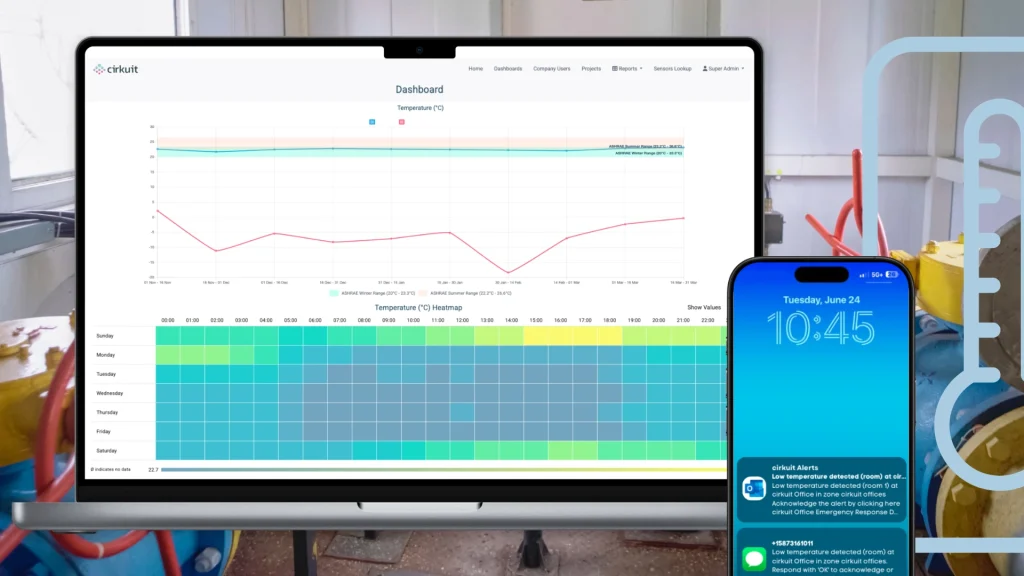
During a deep freeze, temperatures dropped to nearly -30°C. At one property, a temperature sensor triggered an alert: the mechanical room had dropped to 3°C and was still falling.
Mechanical rooms are meant to maintain stable conditions. A rapid drop signals that something has already gone wrong.
This particular room was located along an exterior wall and accessed through a man-door — a setup that becomes especially vulnerable during extreme cold.
When the property manager arrived on site, the issue was clear:
- Snow drifting under the exterior access door
- A failed heating unit
- A continued drop in room temperature
- Pipes exposed and nearing freezing conditions
The system was only hours away from failure. A further drop would have caused the pipes to freeze, expand, and eventually burst.
Instead, heat was restored and the issue was contained before any damage occurred.
No repairs. No insurance claim. No disruption.
The difference was simple: the issue was identified early enough to act.
Why Temperature Sensors Matter in Commercial Buildings
Most building failures are not sudden events. They result from gradual changes that go unnoticed.
As portfolios grow and teams become more stretched, physically checking every space becomes unrealistic. Routine inspections still matter, but they only provide snapshots — not continuous visibility.
At the same time, the cost of failure continues to rise. Water damage caused by freezing pipes remains one of the most common and expensive risks in commercial properties, as noted by the Insurance Institute for Business & Home Safety.
Many of these incidents are preventable, but only if they are identified early. Temperature sensors close that gap by monitoring conditions continuously, not periodically.
Where Temperature Risks Actually Exist
Temperature issues rarely start in high-traffic areas. They develop in spaces that are easy to overlook and rarely checked.
Common risk zones include:
- Mechanical rooms, especially along exterior walls
- Rooftop HVAC units exposed to extreme weather
- Pipe runs in unconditioned spaces
- Electrical or service rooms with inconsistent heating
- Vacant units with reduced systems
Because these areas aren’t tied to tenant comfort, problems often go unnoticed until damage has already begun.
The Limits of Manual Monitoring
Many buildings still rely on routine inspections to monitor conditions. While this approach has worked in the past, it becomes difficult to maintain at scale.
Manual monitoring has clear limitations:
- It is scheduled and infrequent
- It depends on physical presence
- It misses issues that develop between visits
In fast-changing conditions, these gaps become critical. A heating failure during a cold snap can create serious risk within hours.
Temperature sensors remove this delay by providing continuous monitoring and real-time alerts when conditions begin to shift.
How Temperature Sensors Provide Early Warning
The value of temperature sensors lies in their ability to highlight change — not just report static conditions.
Instead of simply showing a reading, they identify when a system is moving toward failure. This includes:
- Detecting rapid drops in temperature
- Identifying deviations from normal ranges
- Triggering alerts when thresholds are crossed
This turns temperature into an actionable signal.
Standards from organizations like ASHRAE emphasize maintaining stable conditions, but without real-time monitoring, those standards are difficult to enforce. Temperature sensors make it possible to act in real time.
What Would Have Happened Without That Alert
If the issue had gone unnoticed, the outcome would have followed a predictable path.
As temperatures dropped below freezing:
- Water inside pipes would expand
- Pressure would build
- Pipes would crack or burst
- Water would flood the mechanical space
From there, the impact would escalate:
- Damage to equipment and infrastructure
- Emergency repair costs
- Insurance claims
- Tenant and operational disruption
What started as a temperature issue would quickly turn into a costly event.
The ROI of Temperature Sensors Is Immediate
In this case, the cost to install temperature monitoring was under $2,000. The potential damage avoided would have been significantly higher.
Preventing a single incident justifies the investment.
More importantly, avoiding emergency situations reduces disruption, protects operations, and gives teams more control over building performance.
Beyond Freeze Prevention: Additional Use Cases
While freeze prevention is a primary use case, temperature sensors support broader operational goals.
They can help teams:
- Monitor HVAC performance
- Identify heating and cooling inefficiencies
- Validate conditions in low-use spaces
- Support energy and reporting initiatives
Tools like ENERGY STAR Portfolio Manager rely on accurate environmental data to assess building performance. Temperature is a key input in understanding how a building operates.
A Shift Toward Proactive Building Operations
Building operations are shifting from reactive to proactive.
Temperature sensors extend visibility across properties without requiring constant physical checks. They allow teams to monitor critical conditions in real time and respond when it matters most.
This doesn’t replace existing workflows — it strengthens them.
Key Takeaways for Property Management
The most significant risks in a building are often the least visible.
Temperature is one of the earliest indicators that something is wrong, especially in spaces that aren’t regularly monitored. When those signals are missed, small issues can quickly become major problems.
For property teams, the takeaway is simple: better visibility leads to better outcomes.
Temperature sensors provide that visibility, allowing teams to act earlier, reduce risk, and maintain control over building performance.
And in situations like the one described above, that early action makes all the difference.